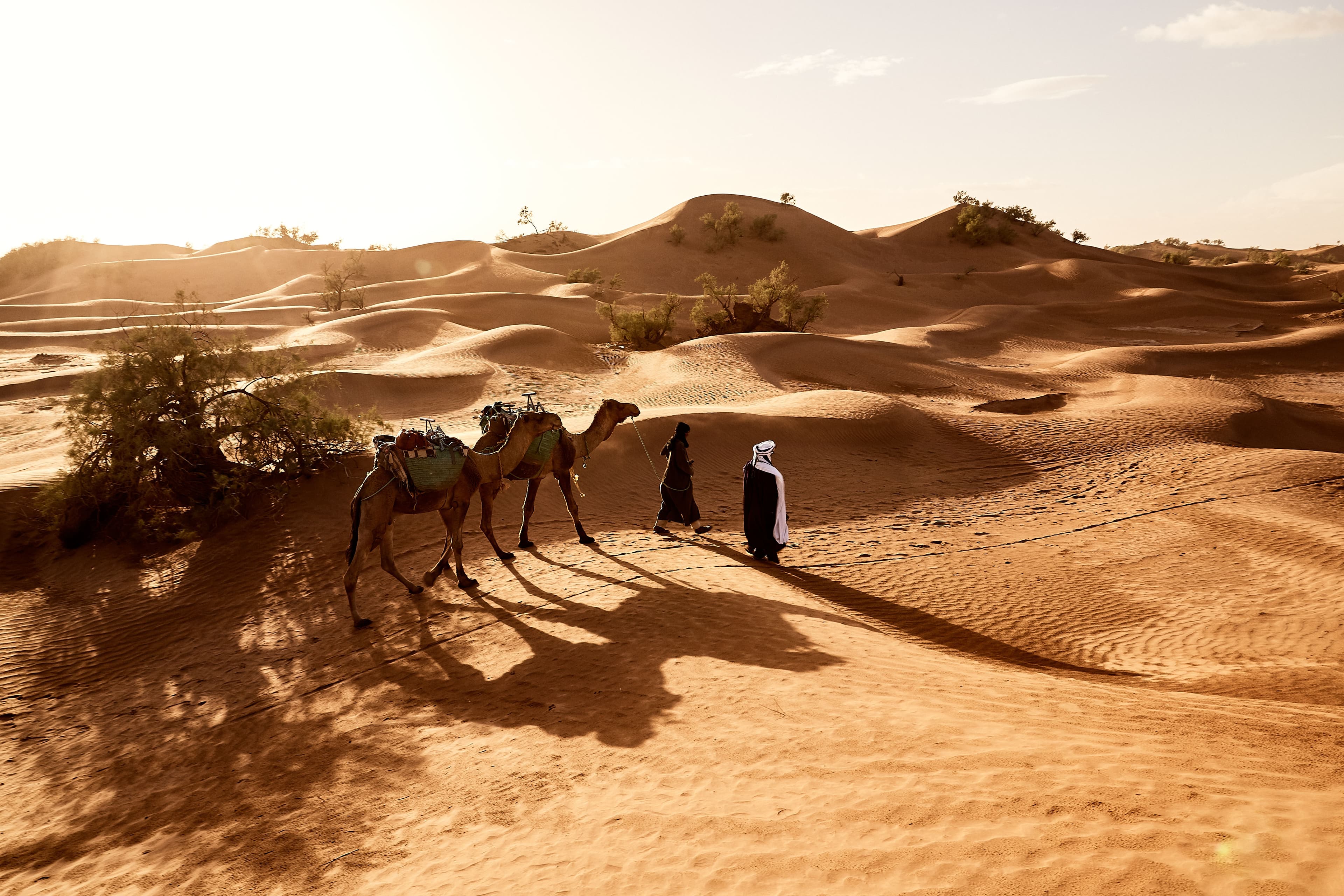
What is a 2-day Marrakech desert tour?
A 2-day desert tour from Marrakech targets Merzouga and Erg Chebbi — the full Sahara, 560km from the city — but compresses the entire round trip into 48 hours. The route crosses the High Atlas via the Tizi n'Tichka pass, drops through Ouarzazate, and follows the Route of a Thousand Kasbahs to the desert. The same road in reverse on Day 2.
Typical 2-day itinerary
What travelers experience
The desert is real. The dunes at Erg Chebbi are spectacular. The camel ride happens. The camp exists. But the ratio of time in a vehicle to time in the desert is deeply unfavorable. Most travelers spend 18–20 hours driving for 3–5 hours of actual desert experience — and much of that is in the dark. The sunrise is real, but the clock is always running.
What is a 3-day Marrakech desert tour?
A 3-day tour covers the identical distance to Merzouga — but distributes it across three days with a hotel or guesthouse night at the Dades Gorge midway. The result is that every leg of the journey takes 4–6 hours instead of 9–10, and each driving block ends at something worth seeing: the dramatic canyon of the Dades, the narrow slot of Todra Gorge, and finally the dunes themselves.
Typical 3-day itinerary
The critical difference on Day 2 is arriving at Merzouga at 3–4pm with daylight to spare. You have time to walk the dunes yourself, watch the light change across Erg Chebbi's 150-metre ridges, and begin the camel ride to camp with the sun still above the horizon. The evening at camp is leisurely. The stargazing — Morocco's skies are extraordinarily dark at this distance from any city — feels like its own event.
Compare 3-day desert tours on Travilto →Key differences explained
Travel pace and road fatigue
The Marrakech–Merzouga route is approximately 560km one way. Both the 2-day and 3-day tours cover that same distance — the difference is purely in how it is split. On a 2-day tour, Day 1 involves 9–10 hours of driving. Day 2 involves the same in reverse. On a 3-day tour, no single day exceeds 5–6 hours behind a wheel, and every driving block ends at a specific sight.
Road fatigue is consistently the most common complaint from travelers who choose the 2-day option. The Moroccan roads between Marrakech and Merzouga are well-maintained but narrow and winding through the Atlas. Ten hours of this in a single day is genuinely tiring for most adults — and difficult for children and older travelers.
Scenic stops and route variety
The 2-day tour typically includes one meaningful stop: Ait Benhaddou, the UNESCO-listed ksar — usually 20–30 minutes, enough for photos but not for the full climb to the top of the fortified village. The 3-day tour includes Ait Benhaddou (properly), a lunch break in Ouarzazate, a walk in Dades Gorge, and a stop at Todra Gorge — a 300-metre-deep slot canyon accessible on foot.
These stops are not padding. Todra Gorge and Dades Gorge are legitimate travel destinations in their own right. Many travelers who do the 3-day circuit find the gorge sections as memorable as the desert itself.
Desert immersion and time at camp
This is where the tours diverge most sharply. On a 2-day tour, you arrive at the edge of Erg Chebbi around 6–7pm. A quick camel ride gets you to camp around dusk. Dinner at 8pm. Sleep. You are woken at 5am for the sunrise, back at camp by 6:30am, and in the vehicle by 8am. Your total awake time in the desert: roughly 2–3 hours.
On a 3-day tour, you arrive at 3–4pm. You have time to free-roam the dunes before the camel ride. Sunset happens while you are positioned at altitude. Camp is leisurely: tea, live music, a proper dinner, and an unrushed stargazing session. Total awake desert time: 6–8 hours or more.
Comfort and overnight quality
Camp quality is identical regardless of which tour duration you choose — it depends on which operator and tier you book, not on whether you took 2 or 3 days to get there. The comfort difference between the tours is in the journey, not the destination.
The 3-day tour adds a hotel or riad night at Dades Gorge. These guesthouses range from simple family-run rooms (€20–35/person) to stylish boutique riads with gorge-view terraces (€60–100). Many travelers consider this intermediate night one of the trip's surprises — the gorge is dramatic, quiet, and genuinely beautiful after dark.
Photography opportunities
The 3-day tour offers significantly more photography windows. The Tizi n'Tichka pass, Ait Benhaddou at golden hour, the layered canyon walls of Dades Gorge, the towering vertical slabs of Todra — and then the dunes. The 2-day tour rushes past most of these. If photography drives your itinerary, the choice is clear.
At camp, the 3-day tour guarantees a proper sunset shoot from the dune crest and ample time for milky way photography — the skies above Erg Chebbi are extraordinarily dark. The 2-day traveler gets the sunrise only, with a departure countdown running from the moment they wake.
Who should choose the 2-day tour?
Who should choose the 3-day tour?
Is the 3-day tour worth the extra cost?
The cost difference between a 2-day and 3-day tour is real but smaller than most travelers expect. The extra night in the Dades Gorge area — often a simple guesthouse — adds €20–40/person to the operator's cost. The extra day of guiding and transport adds another €20–40. The total premium is usually €40–80 per person on a group tour — less on a larger group.
At the budget group level, the jump from €100 to €150 buys you an additional full night in the gorges, three extra legitimate attraction stops, and 4–5 more hours of actual desert time. Most experienced Morocco travelers consider this one of the better value-for-money upgrades available in Moroccan tourism.
Common mistakes travelers make
Our recommendation
Take 3 days if there is any way to make it work with your itinerary. The cost difference is modest. The experience difference is large. This is not a close call for most travelers.
If you have 6 or more days in Morocco, build the desert circuit as a 3-day module: Marrakech → Dades Gorge → Merzouga → return. This leaves 3 days for the imperial cities, coast, or Atlas — and makes the desert a genuinely memorable centrepiece rather than an endurance event. The full Marrakech to Merzouga guide covers every stop and decision on this route.
If you have 4–5 days total, a 2-day Merzouga tour is still achievable — but go in knowing what you are accepting: two long driving days and limited desert time. Alternatively, consider a 2-day Zagora circuit: shorter drive, well-paced, and genuinely satisfying. Our Merzouga vs Zagora comparison helps you pick the right destination for your timeline.
If you only have 3 days in Morocco total, do not spend all three on a desert circuit. Consider spending one night in the Agafay Desert — 35km from Marrakech, no major travel required — and saving Erg Chebbi for a future trip where you can do it properly.
For families, 3 days is non-negotiable. The logistics of a 2-day Merzouga trip with children under 12 are manageable but stressful. The 3-day version is structured in a way that children enjoy — short drives, interesting stops, a gorge night, and an unhurried desert arrival.
Frequently asked questions
Is 2 days enough for Merzouga?+
Technically possible, but most travelers regret it. A 2-day Merzouga circuit means roughly 9–10 hours of driving on Day 1 and the same on Day 2 — for a few hours in the desert in between. You arrive at camp close to or after sunset, wake at 5am for the sunrise, then spend the entire second day in a vehicle. If you only have 2 days, a Zagora tour is a far better choice. For Merzouga, 3 days is the minimum that does it justice.
Is 3 days too long for a Marrakech desert tour?+
No. Three days is the sweet spot for a Merzouga circuit from Marrakech. Day 1 is Marrakech to Dades Gorge via Ait Benhaddou and Ouarzazate — all legitimate highlights in themselves. Day 2 continues through Todra Gorge to Merzouga with a proper afternoon, sunset camel ride, and a full night at camp. Day 3 brings sunrise and a comfortable drive home. Nothing feels rushed.
Which desert tour is less tiring — 2 days or 3 days?+
The 3-day tour is significantly less tiring, even though it is one day longer. The total road distance is identical — around 1,100–1,200km round trip — but spread across three days in 4–6 hour blocks with meaningful stops between them. The 2-day tour compresses that same driving into two consecutive 9–10 hour days. Road fatigue is the most common complaint from travelers who choose 2 days.
Which desert tour is better for families?+
The 3-day tour is better for most families. Shorter daily driving blocks mean children arrive at each stop with energy rather than exhaustion. The intermediate night in the Dades Gorge area breaks the journey in a way that makes the whole trip more enjoyable. If 3 days is impossible, a 2-day Zagora tour (5–6 hours each way) is a much gentler option than a 2-day Merzouga attempt.
Which tour gives more time in the desert?+
The 3-day tour, by a wide margin. On a 2-day Merzouga tour you typically arrive at camp near or after sunset and leave the next morning — roughly 12–15 hours total at the desert, most of it asleep. On a 3-day tour you arrive by 3–4pm on Day 2, giving you a full late afternoon on the dunes, sunset, overnight, and an unhurried sunrise — 18–22 hours at the desert with far more of it spent actively exploring.
Is the extra day on a 3-day desert tour worth it?+
Yes, for most travelers. The extra day adds stops at Ouarzazate, Dades Gorge, and Todra Gorge — all genuinely spectacular — transforms a punishing drive into a scenic road trip, and gives you a proper afternoon in camp rather than arriving after dark. The cost difference is €40–80 per person on group tours. That premium buys a fundamentally better experience, not just an extra hotel night.
Can you reach Merzouga comfortably in 2 days from Marrakech?+
You can reach Merzouga in 2 days, but 'comfortably' is a stretch. The route is approximately 560km and takes 9–10 hours with only a short stop at Ait Benhaddou. Most operators include that 30-minute stop. You arrive at camp after dark. Many travelers accept this once, but few describe the 2-day version as comfortable — the return journey adds another full day of identical driving.
Which option gives better camp experiences?+
The 3-day tour, because you arrive with daylight remaining. On a 2-day tour you reach camp around or after sunset — the camel ride is rushed, dinner follows quickly, and a 5am wakeup limits how much you actually enjoy the night. On a 3-day tour you arrive by mid-afternoon, have time to walk the dunes before the camel trek, watch the full sunset from altitude, and experience the campfire and stargazing at a relaxed pace.
How many days should I spend on a Sahara tour from Marrakech?+
Three days is the minimum that gives Merzouga the time it deserves. Four days allows the return route to vary — through Midelt and Ifrane, or south via the Draa Valley — so you avoid driving the same road twice. If you genuinely only have 2 days, a 2-day Zagora tour is a better experience than a rushed 2-day Merzouga attempt.
Related guides
Ready to book?
Compare live 2-day and 3-day tour options — matched to your exact itinerary.
Free to use · Verified tour operators · Local guide knowledge