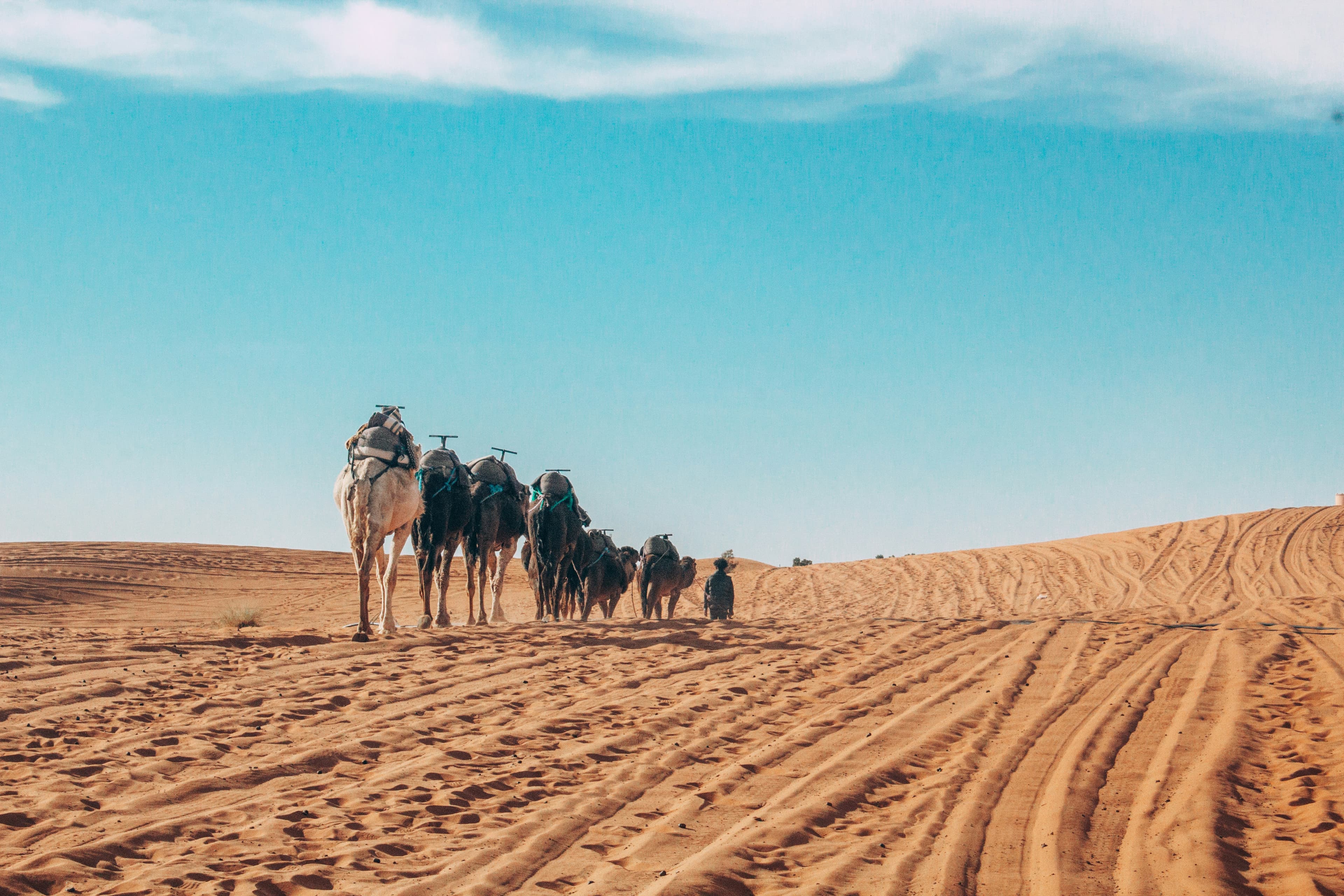
What is Merzouga?
Merzouga is a small town in southeastern Morocco, sitting directly at the base of Erg Chebbi — one of Morocco's two great sand seas and the country's most iconic desert landscape. The dunes rise to 150 metres, stretch roughly 22km from north to south, and glow orange, red, and gold depending on the light. This is an unambiguous, full-scale Sahara desert.
The silence is complete once you're away from the camp perimeter. At sunrise, the shifting shadow lines across the dune faces create depth and texture that's nearly impossible to photograph badly. Most tours spend two nights here, breaking the drive in both directions through the Route of a Thousand Kasbahs: Ouarzazate, the Dades Gorge, Todra Gorge — all legitimate highlights that make the journey itself worthwhile.
What is Zagora?
Zagora is a town in the Draa Valley, about 340km from Marrakech, famous for its palm groves, crumbling kasbahs, and a road sign that reads "Timbuktu — 52 days by camel." The valley itself is beautiful — a long green corridor of date palms and mud-brick villages cutting through arid plateau — but the desert experience near Zagora is more muted than most travelers expect.
The dunes closest to Zagora are the Tinfou dunes, about 28km south of town. They are genuinely scenic at sunset, but they are pre-Saharan in character — sandy ridges rising 5–20m rather than a sea of towering dunes. Many travelers arrive expecting Erg Chebbi and find something considerably more modest. This is the most important distinction to understand before booking.
A true Saharan experience from this direction requires continuing 90km further south to M'hamid el Ghizlane and then crossing a 50km unpaved piste to Erg Chigaga — a remote erg with dunes up to 300m. That is a different, longer trip not included in standard 2-day Zagora tours.
Ask Travilto about Zagora vs M'hamid →Key differences explained
Distance and travel time
The drive from Marrakech to Merzouga takes 9–10 hours via the most scenic route — over the Tizi n'Tichka pass, through Ouarzazate, along the Dades and Todra gorges. Most operators split this over two driving days. Zagora is 5–6 hours on the same pass, turning south before the gorges.
That 4-hour gap is the difference between a 2-day trip and a 3-day trip; between arriving exhausted or arriving ready. If you're combining the desert with Fes, the Atlas Mountains, or Essaouira, Merzouga needs to be built into a longer itinerary to justify the round-trip drive time.
Desert landscape
Erg Chebbi is a proper Saharan erg — a large area of wind-sculpted dunes with no breaks, no scrub, no rocks visible from the dune peaks. The color is vivid: deep amber at midday, nearly red at sunset. The scale makes you feel genuinely small. The Tinfou dunes near Zagora are pleasant but on a fundamentally different scale. The comparison is closer to large coastal dunes than the Sahara.
Camp quality
Merzouga's camp ecosystem spans a much wider quality range. Budget bivouacs (€20–40/person) offer a shared Berber tent and basic facilities. Mid-range camps (€60–100) provide private tents with beds, electricity, and good food. Luxury camps (€150–300+) include en-suite bathrooms, plunge pools overlooking the dunes, and candlelit dinners.
Zagora camps are generally comfortable mid-range. The luxury tier is thinner. At both destinations, the gap between a good camp and a disappointing one is significant — always read recent reviews and ask about camp capacity before booking.
Camel ride experience
At Merzouga, the camel trek to your camp typically takes 45–90 minutes as you ride through and over the dunes themselves. You arrive at camp having genuinely crossed terrain. At Zagora's Tinfou dunes, the ride is 20–40 minutes on much smaller topography. The sense of immersion is proportionally lower.
Authentic Sahara feel
Merzouga is more authentically Saharan. Erg Chebbi is remote, vast, and genuinely disconnected from urban Morocco. Berber and nomadic culture is more present in the region — you'll see nomad families camped in the surrounding hamada. Zagora's Draa Valley is historically rich as one of the main trans-Saharan caravan routes, but "authentic desert" near Zagora means the valley itself, not the dunes.
Who should choose Merzouga?
Who should choose Zagora?
Merzouga vs Zagora by traveler type
First-timers often prioritize seeing 'real' dunes — Merzouga delivers this emphatically. But if your itinerary is tight, Zagora's shorter drive gets you a desert night without sacrificing Marrakech time.
The drive length is the deciding factor. 5–6 hours is manageable with children; 9–10 hours is hard. The smaller dunes near Zagora are also safer and easier for young children to climb.
Merzouga's luxury camp ecosystem is the most developed in Moroccan desert travel — private en-suite tents, plunge pools, gourmet food, and dune-sea views. Zagora can't match this tier.
Budget travelers can do Zagora for €70–90 on a group tour. Merzouga group tours start around €130 but the experience is proportionally better. If you can stretch €40 extra, Merzouga rewards it.
On a 4-day Morocco trip, spending 2 days driving to Merzouga and back eats nearly half your trip in a car. Zagora's 2-day loop leaves time for the medina and day trips.
Erg Chebbi is one of the most photogenic landscapes in Africa. The scale, color gradation from amber to deep red at dusk, and clean horizon are unmatched. Sunrise here is worth the 5am alarm.
Cost comparison
Prices vary significantly by operator quality, group size, and camp tier. Below are realistic ranges based on verified Travilto operator data.
Best time to visit each desert
The seasonal rules are similar for both destinations — both sit in Morocco's deep south and follow the same climate pattern. The differences are in degree: Merzouga gets slightly hotter in summer and colder at night in winter due to the open erg.
The sweet spot. Warm days (22–30°C), cool nights (10–16°C), minimal crowds. The light is golden and soft — ideal for photography.
Spring warmth without summer heat. Atlas peaks still snow-capped on the drive. Evenings cool enough to need a fleece at camp.
Temperatures at Merzouga regularly hit 45°C+. Camp afternoons become uninhabitable. Some luxury camps close entirely. Zagora is also extreme.
Daytime is fine (18–22°C) but desert nights drop to 0–5°C. A good sleeping bag is essential. Merzouga feels colder due to the open erg and wind.
Common mistakes travelers make
Our recommendation
There is no universally right answer, but there is almost certainly a right answer for your specific trip.
If you have 5 or more days in Morocco and the desert is a priority — go to Merzouga. Build your circuit around the Route of a Thousand Kasbahs: Marrakech → Ouarzazate → Dades Gorge → Todra Gorge → Merzouga, returning via Midelt or south through the Draa Valley. This is one of the best road trips in Africa, and the dunes at the end of it are an appropriate crescendo. See our full Marrakech to Merzouga guide for the complete route breakdown.
If you have 3–4 days total and want at least a day in Marrakech, choose Zagora. The 2-day circuit is compact, the Draa Valley is genuinely beautiful, and you get your desert night without sacrificing the rest of your itinerary. Our Marrakech to Zagora guide covers the circuit in full detail.
If you're traveling with children under 8, Zagora is the practical choice regardless of trip length. No young child needs a 10-hour car journey to have a magical desert experience — and the shorter drive means everyone arrives in better shape to enjoy it.
If you're considering Agafay as a third option: it's a rocky desert plateau 35km from Marrakech — excellent for a quick sunset dinner with no driving commitment, but not a Sahara desert. See our Agafay vs Sahara comparison for full context. It is not a substitute for either destination if a genuine desert night is your goal.
Frequently asked questions
Is Merzouga worth the extra drive?+
Yes — if you have 3 days. Erg Chebbi's 150m orange dunes are visually dramatic in a way the dunes near Zagora are not. The extra driving pays off in scale, camp quality, and authenticity. If you only have 2 days, Zagora is the sensible choice.
Can you do Merzouga in 2 days from Marrakech?+
Technically yes, but it means roughly 18–20 hours of driving across 2 days for a few hours in the desert. Most travelers regret this. A Merzouga trip works best with 3 days minimum so the drive can be broken by stops at Ouarzazate, Dades Gorge, or Todra Gorge — all worth seeing in their own right.
Is Zagora a real Sahara desert?+
The dunes close to Zagora town (Tinfou dunes) are pre-Saharan — scenic but modest at 5–20m. For a full Saharan experience from this direction, you need to continue 90km south to M'hamid and cross piste to Erg Chigaga. Standard 2-day Zagora tours stop at Tinfou.
Which has better desert camps — Merzouga or Zagora?+
Merzouga. The camp infrastructure around Erg Chebbi spans more quality tiers — from basic bivouacs (€20–40/person) to luxury glamping with en-suite bathrooms and pools (€150–300/person). Zagora camps are comfortable but the high-end tier is thinner.
Which is cheaper — Merzouga or Zagora?+
Zagora. Standard 2-day group tours run €70–120/person. Merzouga 3-day group tours run €130–200/person. Private tours cost significantly more for both, but Zagora remains the cheaper option throughout.
Which desert is better for kids?+
Zagora is better for families with young children. The shorter drive (5–6 hours vs 9–10 hours) is the main reason. The smaller dunes near Zagora are also easier for young children to explore safely, and the Draa Valley palm groves add visual variety children enjoy.
Which has bigger dunes — Merzouga or Zagora?+
Merzouga wins decisively. Erg Chebbi's dunes reach 150m and stretch 22km by 5km. The Tinfou dunes near Zagora are 5–20m. Erg Chigaga (accessible from M'hamid, 90km south of Zagora) has dunes up to 300m, but this requires a separate longer trip not included in standard Zagora tours.
Which is more authentic — Merzouga or Zagora?+
Merzouga. Erg Chebbi is remote, vast, and genuinely disconnected from urban Morocco. Berber and nomadic culture is more present. Zagora's Draa Valley is historically rich as a former caravan route, but the dunes near town are less remote. For isolation, scale, and silence — Merzouga.
Related guides
Still deciding?
Compare live desert tour options — get a specific recommendation.
Free to use · Verified tour operators · Local guide knowledge